Gentle reader. I feel that I must begin today’s entry with a few words about the relativity in life. Just as beauty is in the eye of the beholder, valor is measured specific to the individual and circumstance, and one’s success in life and its endeavors can only truly be judged by oneself, we weary pilgrims brothers made a valiant decision for this Sunday’s travel to Padron. After walk 54 kilometers up and down hills in 3 days, arriving too late to enjoy the historic towns we were occupying, tired and sore, facing a rainy Sunday morning, we decided to take an alternative path. One driven by a cab driver.
Faced with a plan to walk the remaining 46 kilometers in two days to stay on our schedule, we made the collective decision that we can define success in our own way. That such a decision was valorous and that we are still beautiful. I have learned that each of us is responsible for our own happiness. We are happily seated at our hotel in Padron content with the success of our decision.
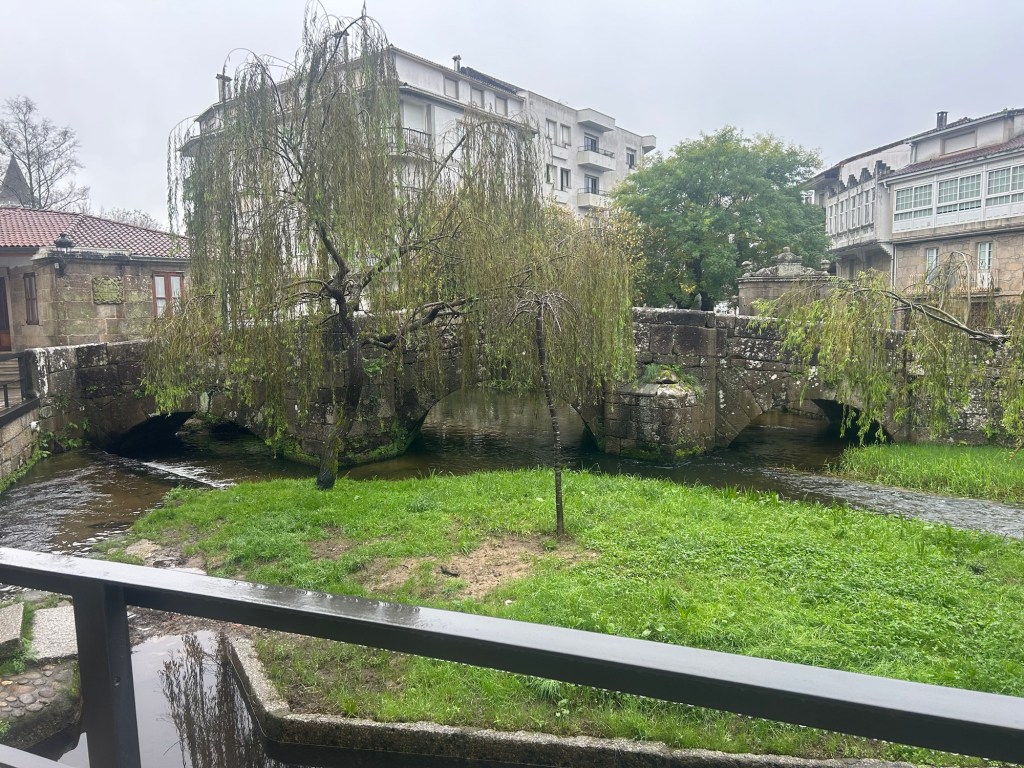
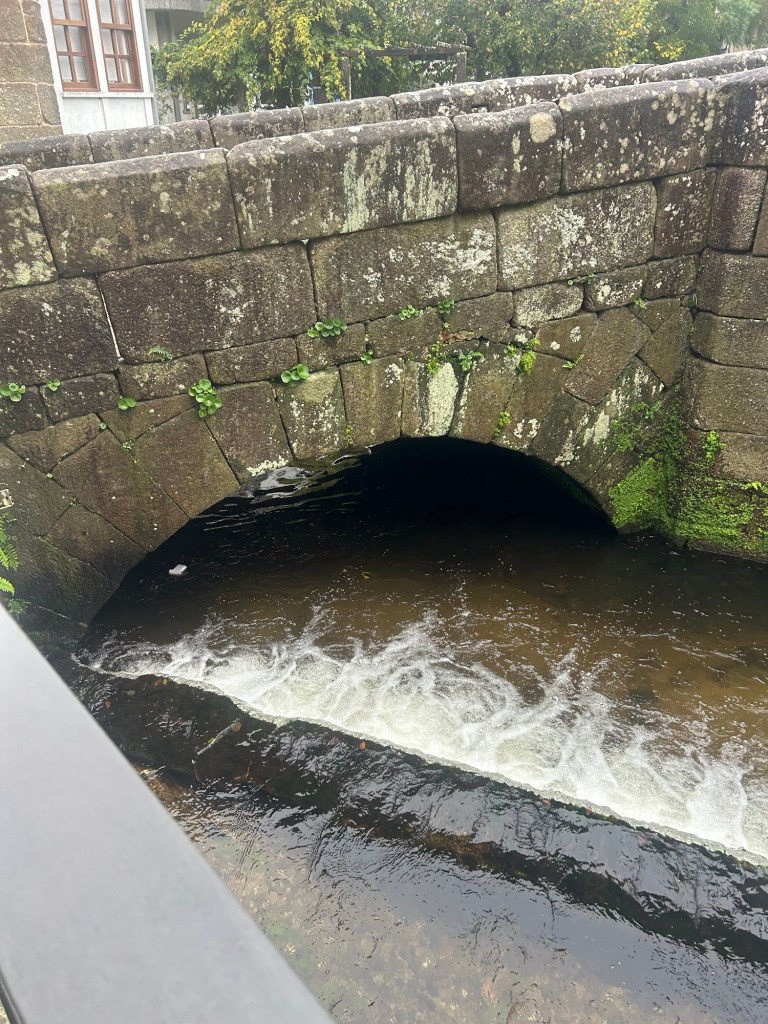
We learned that Caldas de Reis was a popular Roman town whose meaning is Thermal Baths of the kings. It is found at the convergence of two rivers the Bermania and the Umia both bringing fresh water down from the springs in the Galician hills. Before departing town this morning we took a walk about to capture some photos or the Roman Bridge, the thermal baths (which the Spanish health department no longer permits the pilgrims to use). It was a pleasure to have the time to enjoy the town even in the rain.
Padron, located 20 kilometers from the outskirts of Santiago is the legendary starting point of the ministry of St James, the Elder. Santiago. James was assigned to the Iberian peninsula by Christ and like each of the original apostles, brought the word to the natives he found there. It is said that James returned to Jerusalem to tell Peter of a vision he had seen and while there he was beheaded by those opposing Christians. Padron is also the location of his return as his mortal remains were transported by ship by his most loyal disciples after his martyrdom in Jerusalem. They now lie in the center of the cathedral in Santiago de Compostela. Padron is built along the banks of the rivers Star and Ulla. It was the original seat of the bishops before the transfer to the location today in Santiago.
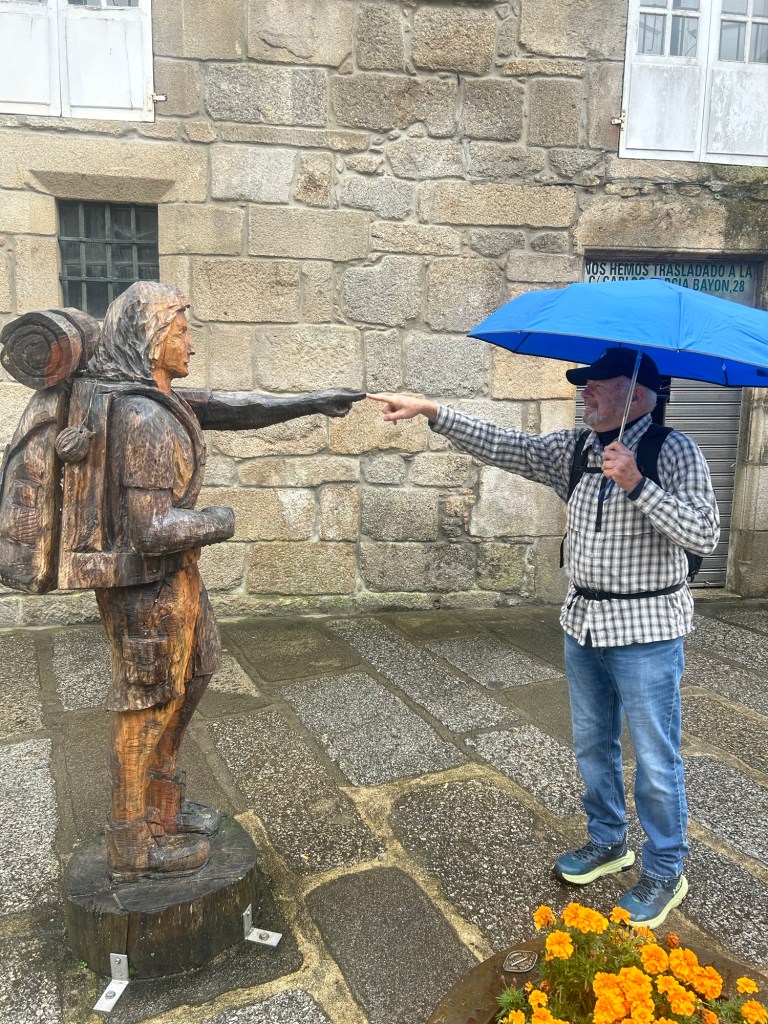
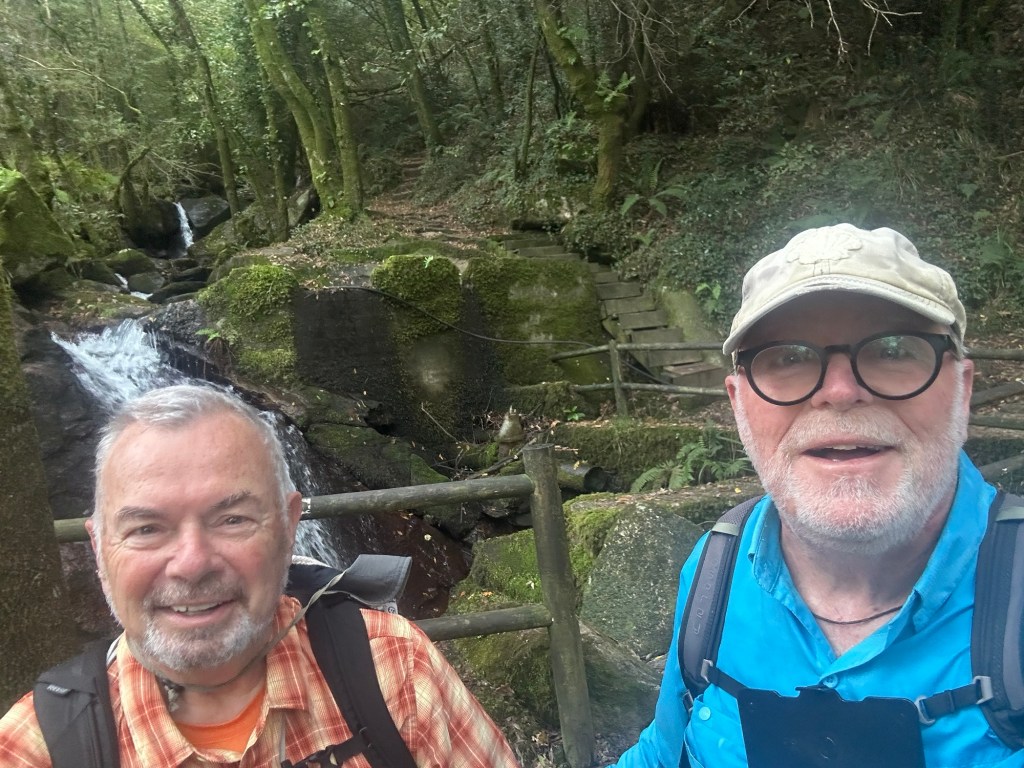
Roman bridge Caldas de ReisRomans made strong bridges still in use today Public fountains Hot water baths for pilgrims to soak tired feet Roman names along their Via XIXTwo handsome pilgrims showing the way
We got an earlier start today since we had a full 25 kilometers to walk. We have learned that in this terrain, about 3 km/ hour is what we can expect so we were looking at 7-8 hours of walking. Blessed with good weather and 52 degrees, we set out on what was advertised as gentle slopes in the dark through city streets.
What locals and “friendly advisors” don’t seem to understand is that gentle slopes is a very relative description. What we have been experiencing has not been gentle for a 75 and 81 year old. Especially the downhills. Joe and I are very compatible walking partners. He climbs up much better than I (since I am carrying much more than he), I am able to walk down better than he (with the younger knees) and we have about the same pace on flat ground.
Exiting a city along the Camino in the early morning is actually a favorite of mine. There is very little traffic which makes the searching for way markers much easier. We experienced pilgrims know to look high and low and near and far for the shell or yellow arrows. They are found on corners of buildings, embedded into the sidewalks and just about everywhere. It is also a joy to see other pilgrims ahead. You can follow them from street corner to corner but keep looking for the way markers yourself. Joe and I were accompanied by a man from Italy who had the GPS program on his phone but told us that he walked 20km in the wrong direction last week.
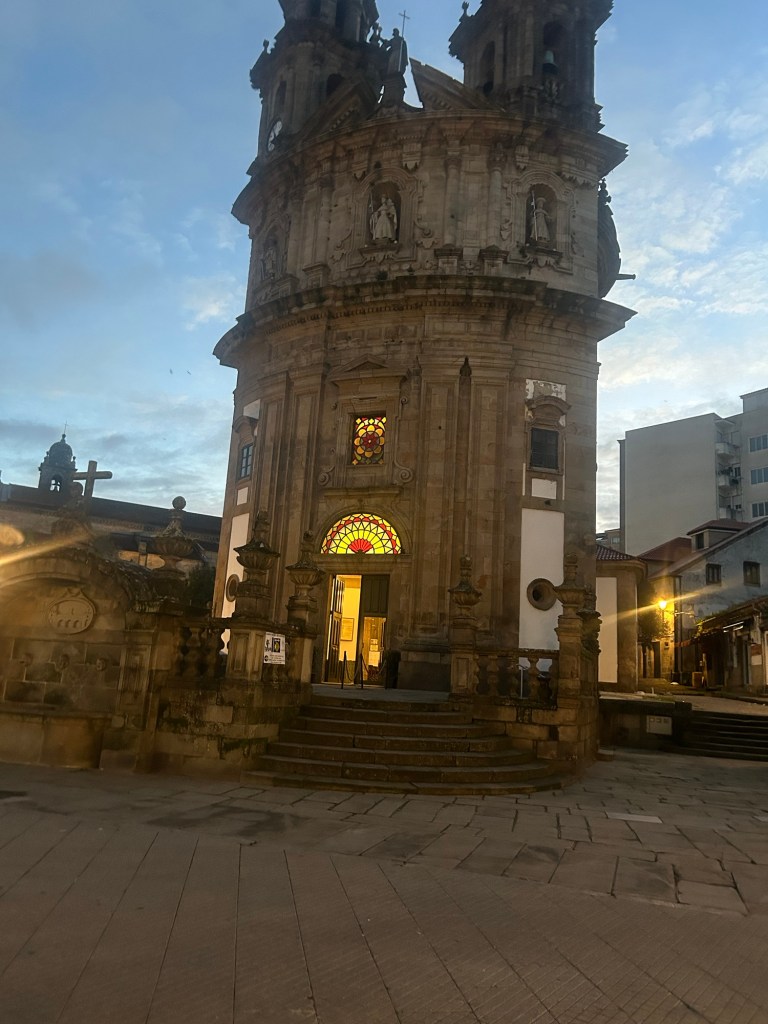
We walked through the Pilgrims Plaza passing the 18th century Chapel built by the Architect Arturo Souto with the floor plan in the shape of the shell. The symbol of the Camino.
Pilgrims Chapel Pontevedra
We have been extremely fortunate with the weather, our accommodations, and the number of pilgrims in November. Yesterday I counted a total of 35 pilgrims from many countries. Mostly Spaniards, Germans, and Americans. This is a very low number and it was easy to count since just about all of them passed us along the way.
Leaving the city early is also enjoyable because of the sounds. It is mostly quiet because of the lack of traffic and city hustle bustle but the crunching of the stones beneath your shoes and the rhythm of your walking sticks are occasionally interrupted by a barking dog, crowing rooster, or the distant sound of a siren.
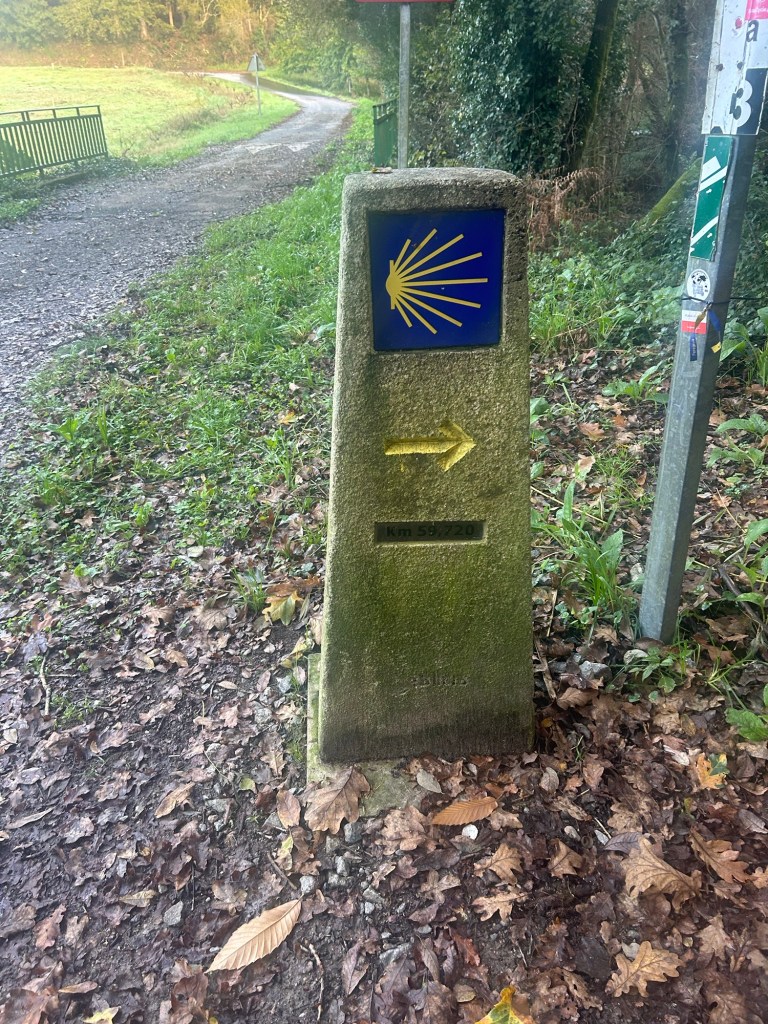
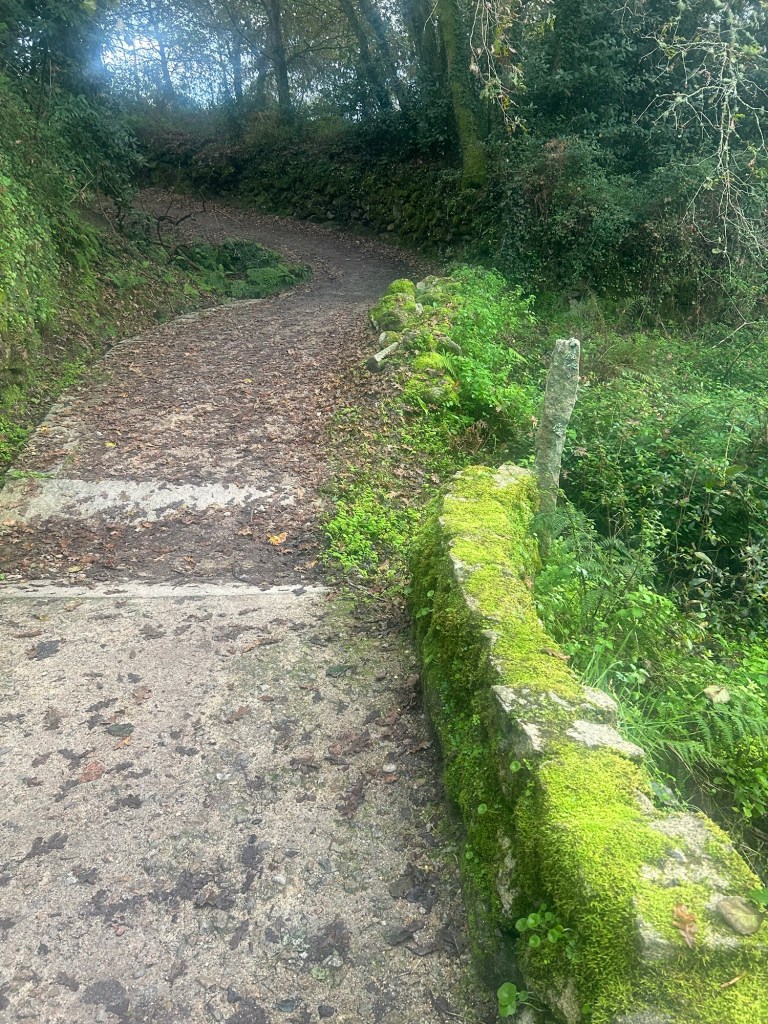
Once out of town we came across an original road sign for the Roman road 19 first built in the year 300 and we were directed into the wooded area along that road toward Caldas de Reis.
Roman road 19Way marker Road 19 through the forest Joe crossing a footbridge in the year 323
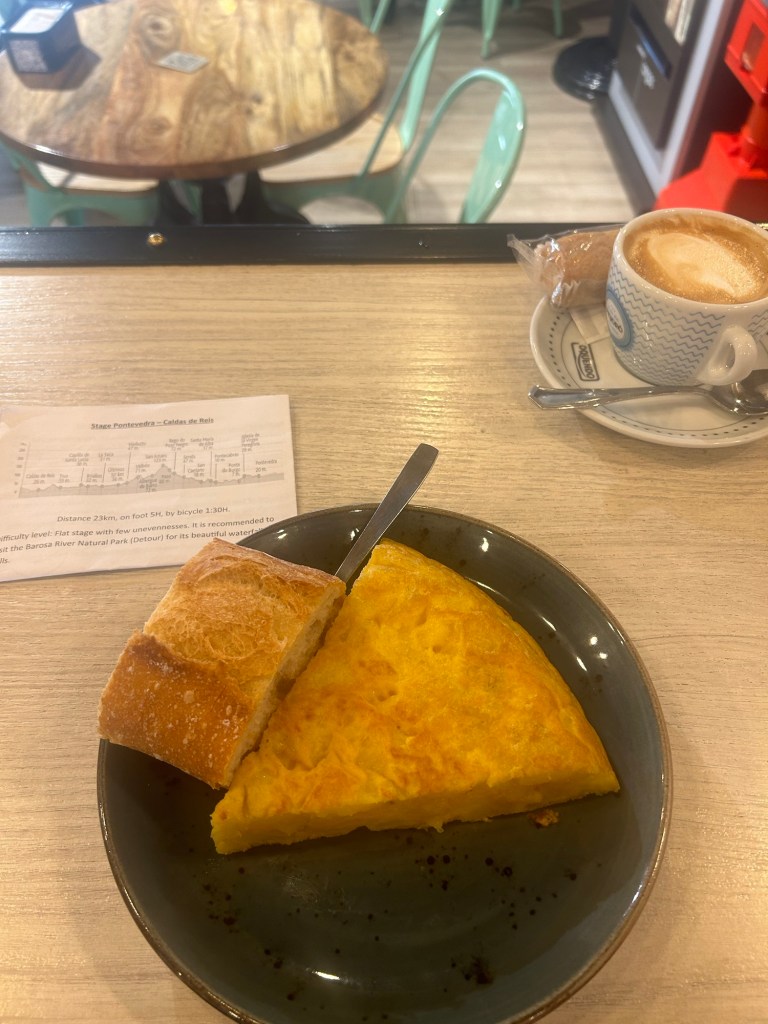
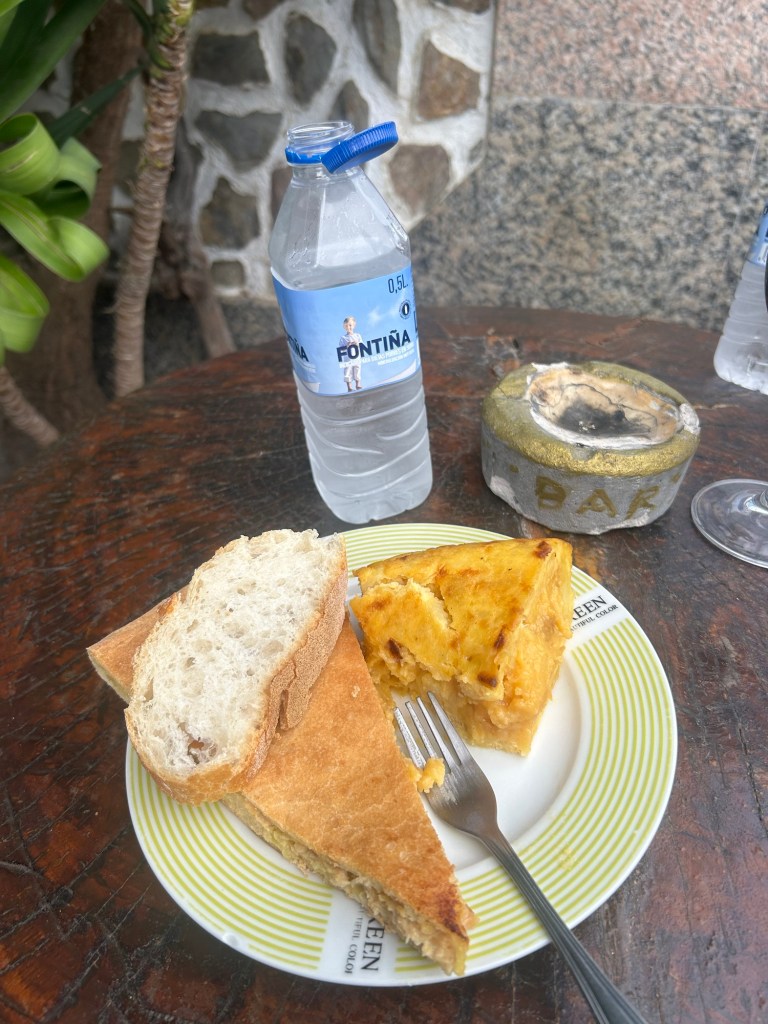
As we knew that today was going to be long, we were pleased to find an excellent restaurant about half way for our traditional “second breakfast “.
Second breakfast Tortilla Española And later, third breakfast
We finally made it to our destination of the proud Galician town of Caldas de Reis with its River Umia, Roman ruins, and hot springs. Seven and a half hours of walking and 36,000 steps. Tired and a bit sore but in time to shower, relax, and blog. Tomorrow on to Padron.
I regret that yesterday’s post was so short but the walk out of Vigo to Arcade was too much for one day. I do try to never focus on the negative aspects of the Camino but it is not a secret to my gentle readers that this is difficult work. Extremely rewarding and spiritually renewing but a physical challenge all the same. Today’s route was a mere 12-14 kilometers but had some very tough climbs (and decents) but was about the right amount of challenge and reward. I logged over 22,000 steps on my Fitbit in our 5 hours of walking today but we got here just as the rain started and were able to shower, have a full lunch, and get our laundry done in time to blog. All good.
We had a fixed dinner last night at a local restaurant in Arcade. Main course was a turbot. (This being the seafood capital of Spain if not Europe). We had arrived too late for lunch so they could have served us anything for dinner and we would have been pleased. Not unusual for Ritchie boys. We woke early and had an 8:00 breakfast and we were on the road at 8:38. To get out of Arcade, we had to walk down hill to the center of town to cross the original Roman bridge where the river Vigo enters the Ria de Vigo it is a one lane bridge that is still in use today. Joe and I paused to watched the bus cross the bridge. We were glad we were not on the bridge at the time.
Puente Romano
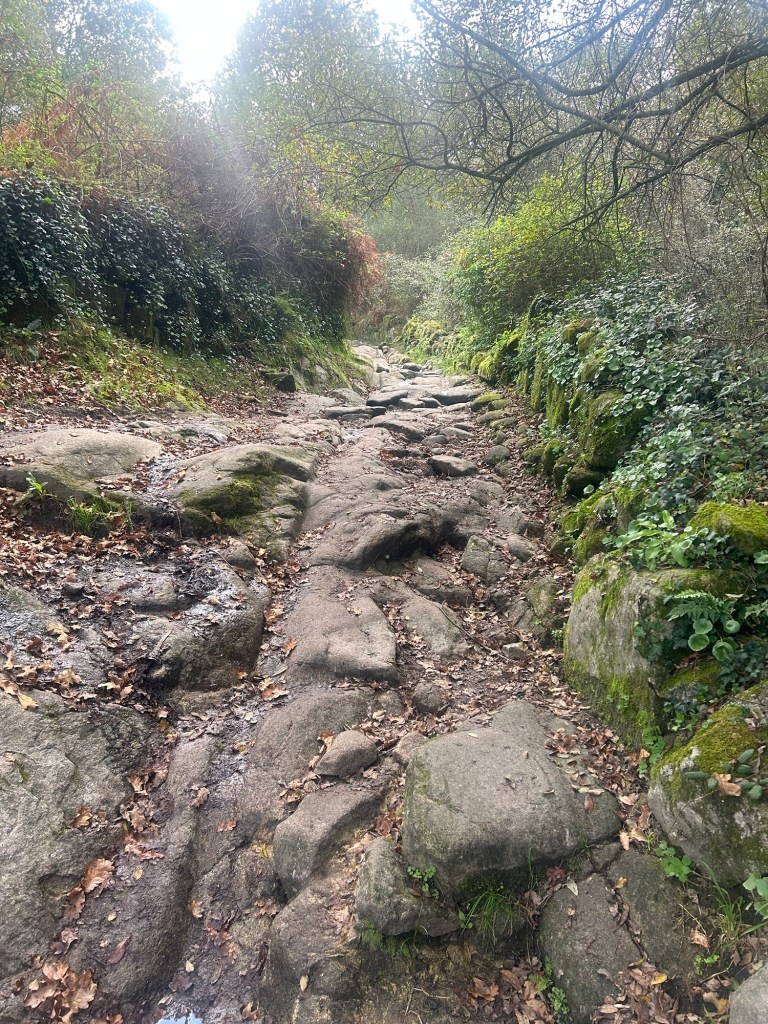
Departing any town on the Camino Portugués means climbing up stones. This went on for miles. Some were paved roads, some dirt, and some were washed out piles of rocks where you had to carefully select your stone to stone path and keep your balance.
Some paths are tougher than others
At 10:00 we passed the way marker that showed that we had completed 25% of our Camino. We passed several gardens and vineyards that have been using the same stone poles and fence posts for centuries.
25%
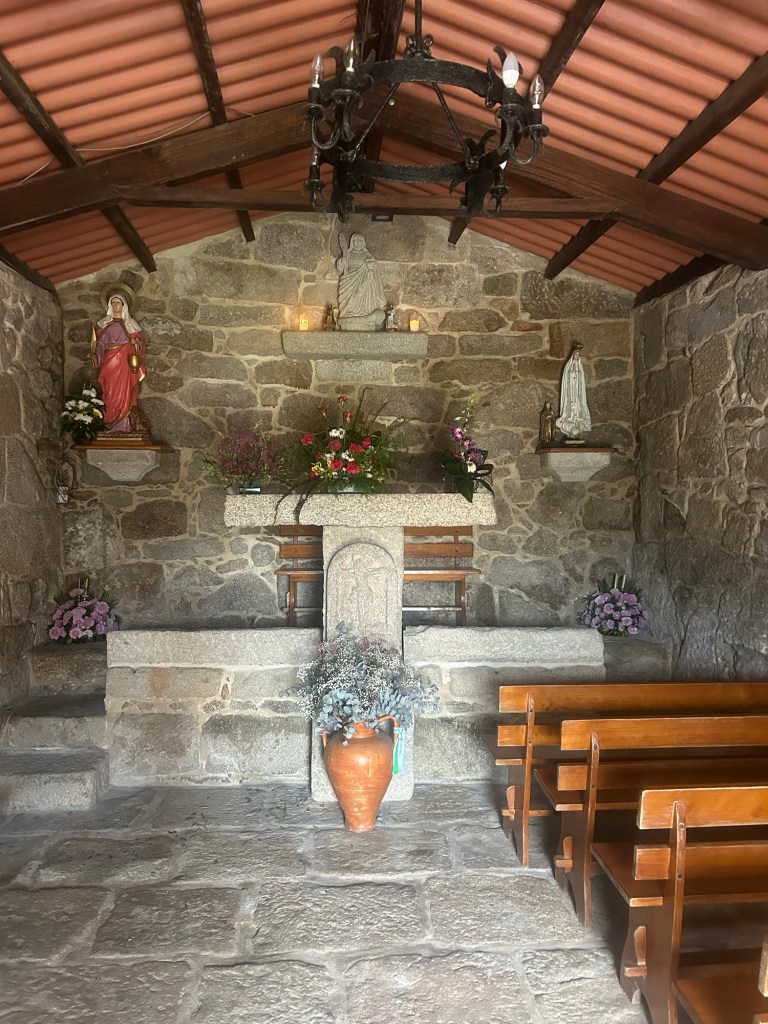
Another highlight of the day was our stop in the tiny chapel of St Marta. We also took a Camino Complementario or alternative route along a river that was a bit longer but very beautiful. It was much better than walking along the highway into Pontevedra.
Alternate route Chapel of Santa Marta
After showering and lunch we found a lavalux and did a few days of laundry.
So today was the start of our Camino. We set out before sunrise and climbed out of Vigo, walked 7 hours and 35,580 steps and we are now resting before dinner. Feet elevated, attended to, and rehydrated. The ups and downs today were a bit extreme for these old knees but the scenery was pretty spectacular.
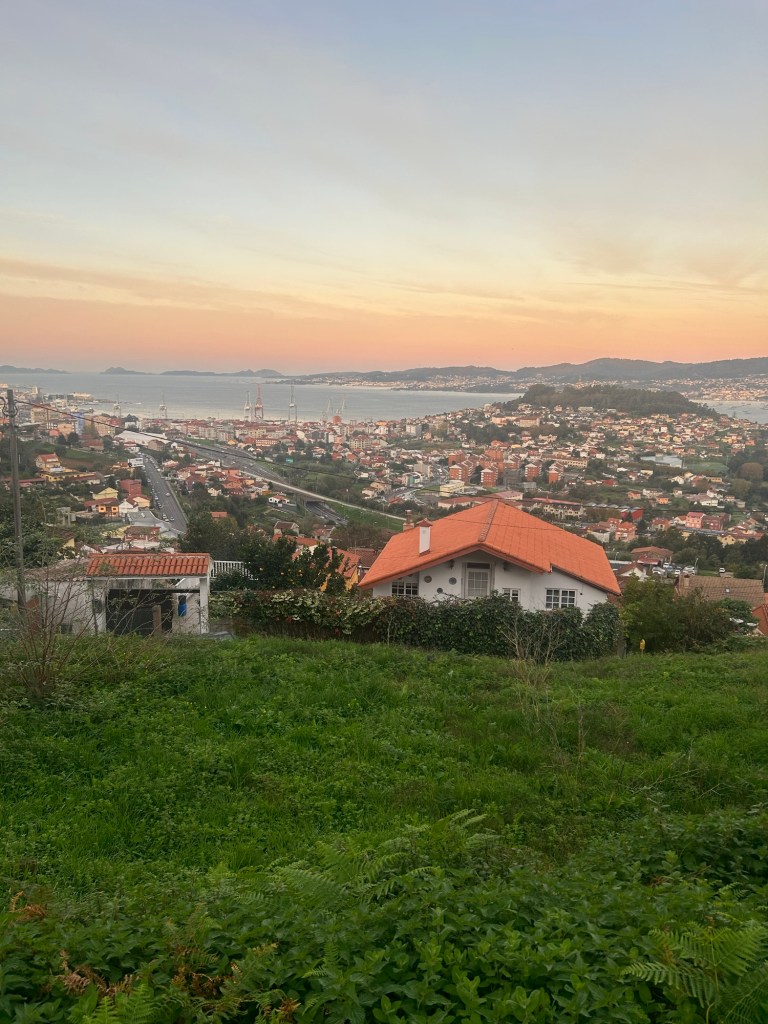
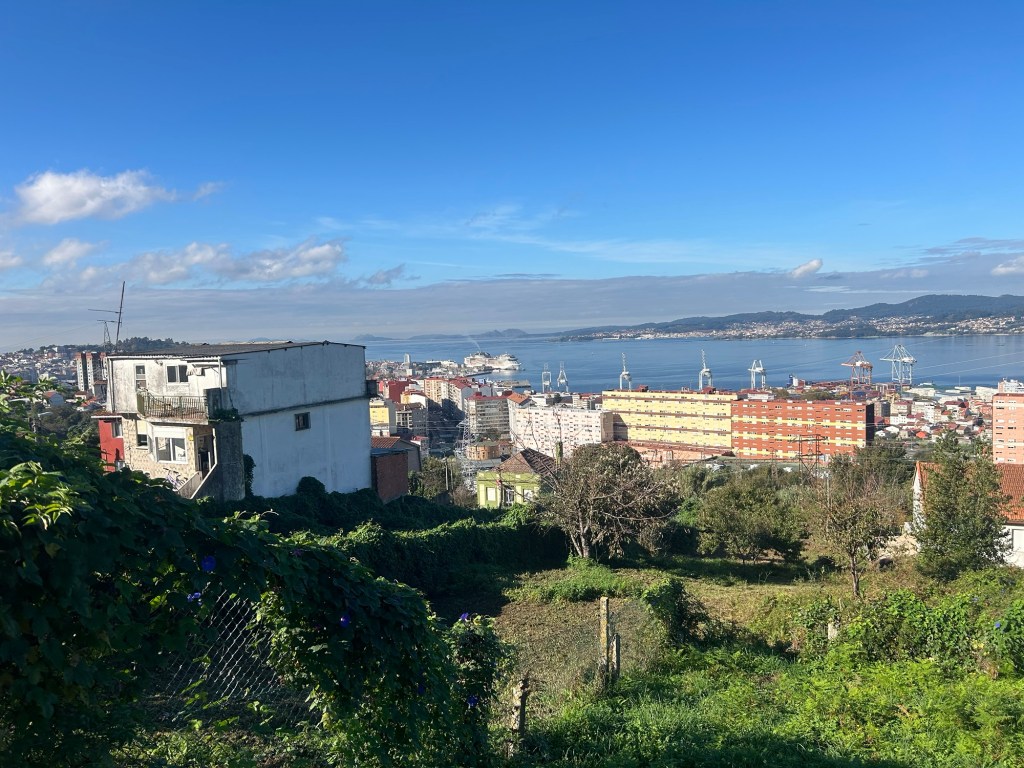
Vigo from above
Once out of the bustling city and associated suburbs, we were treated to a relatively flat trail through the woods along the side of the mountain which forms the Ria, a type of fjord one finds along the Atlantic coast in Northern Portugal and northwest Spain.
The river Vigo empties into the Ria. Navigable inland for 25 km
Scenery along the trail
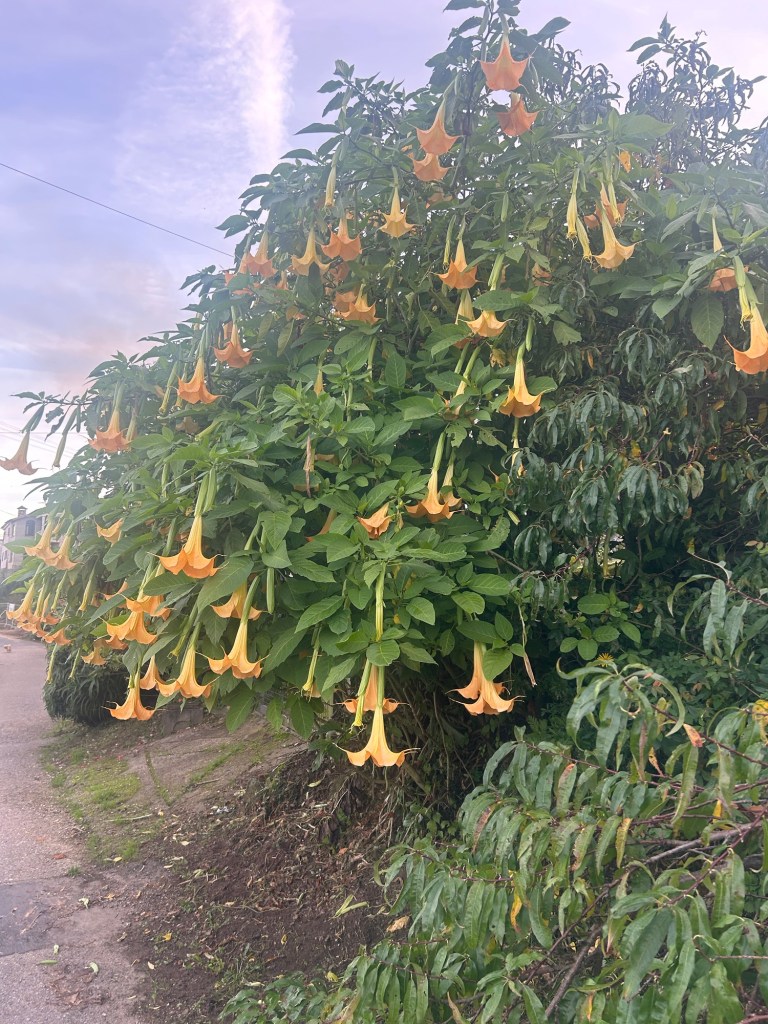
Waterfall on the trail empties into the Ria feeding the musclesThe trail through the Vigo suburbs Trumpet vine tree?
We stopped for second breakfast I Redondela and finally made it to Arcade
A school near our break had a great mural Finally made it
I am pleased to report that Joe and I walked a full 15,000 steps scouting our way out of town this morning. It was a most pleasant adventure. I have written here before that we pilgrims learn quickly the result of early human settlements being near a body of water. The results require pilgrims to walk up hill to get out of town and down hill to get to the next town. We will be doing that climb again in the morning after breakfast.
A significant bonus of our reconnaissance was a near constant reminder of the Camino Angels you find nearly every day
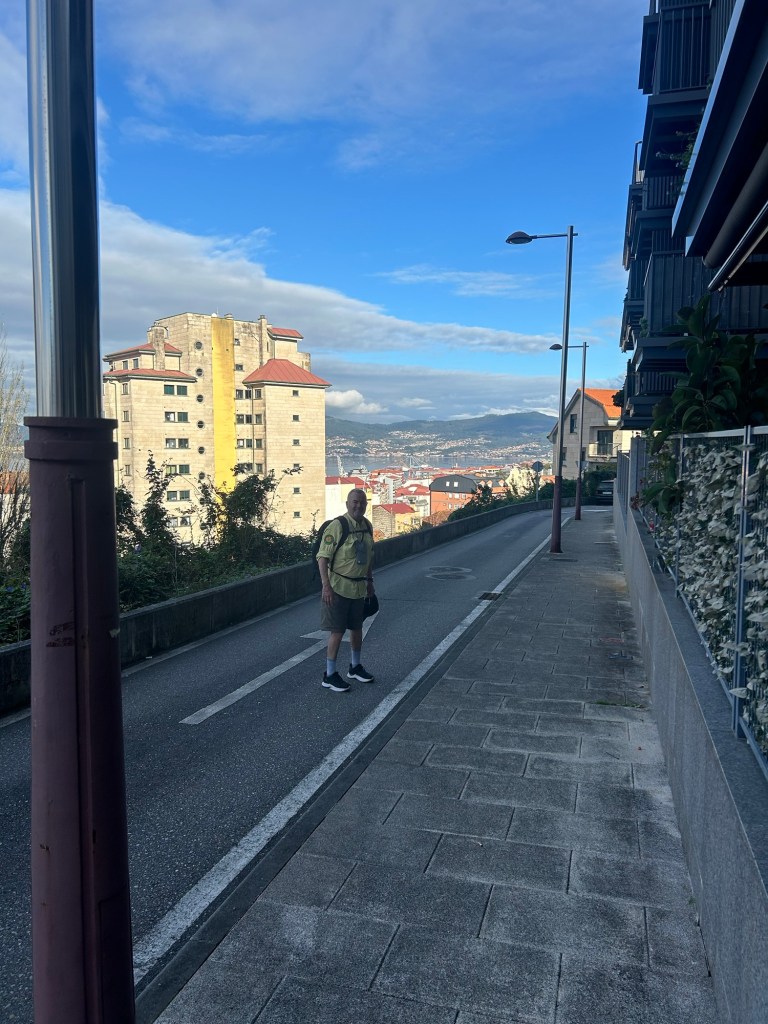
Joe on our climb out of Vigo with the city below
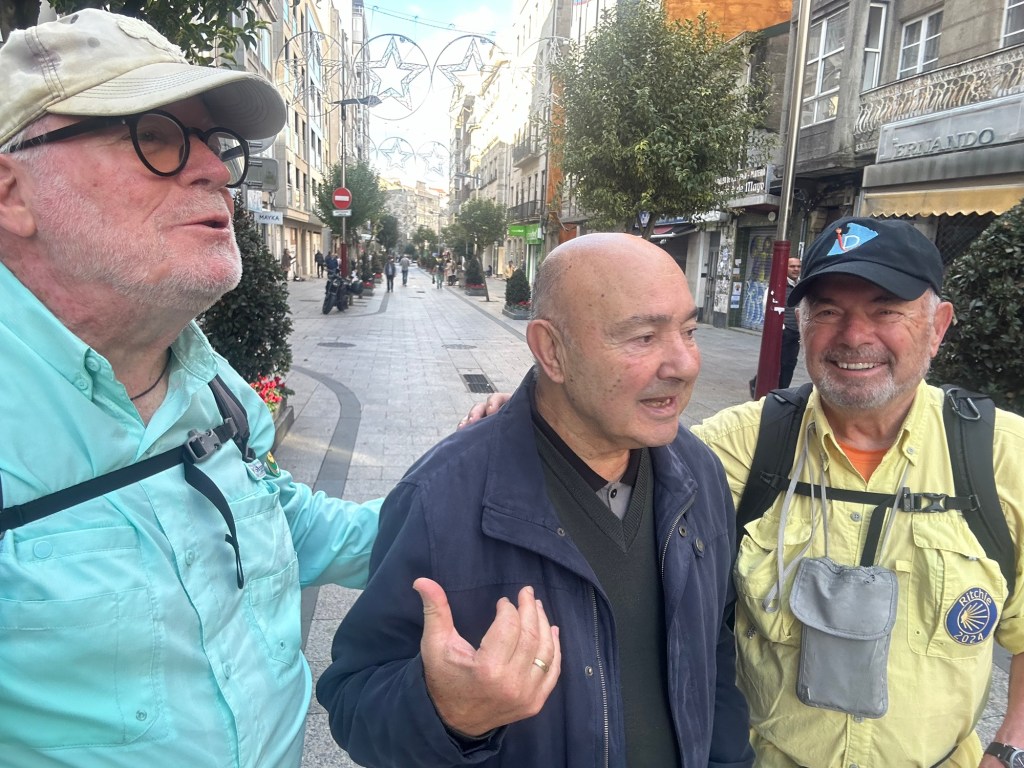
We were stopped more than 10 times by helpful citizens who insisted on explaining to us how to get to the church “Los picos”. It became rather funny but the people were so proud of the Camino ghat we cheerfully listened each time and thanked them profusely
One of our Camino Angels explaining to us the way out of town. Here he is telling another who stopped to tell us the same thing
Walking through the city there are constant reminders that you are not in a US city. The open fruit and vegetable shops, the beautiful murals, and the cheerful happy people are everywhere.
Good morning gentle readers. Our journey to Our start point behind us , we both slept comfortably and were met by a wonderfully full Spanish breakfast. Our plan for today is to scout out the start point for our journey, a church known as Los Picos and see if we can locate the trail makings on the Camino Portuguese.
Vigo is not actually on the Camino Portuguese but a city large enough to have several hotels which is why our travel agency uses it as a starting point. I do not expect to see many hotels like this one along the way.
After our scouting trip this morning, our plan is to visit the oldest part of Vigo and find the best seafood in town for our lunch followed by the Spanish tradition of a siesta before we make our final repacking arrangements for the morning departure. We hope to depart around 7AM as we must have our luggage in the lobby before 8. It will still be dark but with today’s reconnaissance of the way to Los Picos, we should be fine. More later.
After a lovely layover in the Newark airport where Joe and I lounged in the newly renovated United Club (well I lounged while Joe had to shuttle back and forth from concourse to concourse to get his boarding pass) Joe and I met in Concourse B for out Air Portugal flight just after midnight. see photo
I had never been in concourse B and I am not sure I want to ever be there again. B is for Bad. The place was teeming with humanity trying to board crowded flights to places you may never want to go. There were three times the passengers for the number of seats in the waiting area. With bodies sprawled all over the floor, we were able to wrench two unguarded chairs from unsuspecting people. We were boarded about 15 minutes later than planned. The flight was full and the seats were the smallest I have seen since I saw a flight on an Indonesian airline. I did not sleep a wink on the 6 1/2 hour flight.
Customs was uneventful but uninspired as you would expect. Joe was asked how long he planned to stay in Portugal. He told the agent”as long as it takes the driver to get us to Vigo” mercifully, our bags were delivered on the carousel and as we departed the baggage area, we were warmly greeted by Angel, our driver for the two hour drive to Vigo.
The hotel is very nice and the people are nicer still. Vigo was a small fishing town when Jean, Amanda, and I visited it beaded upon the recommendation of one of my professors in 1980. It now is a town of 400,000 where about half are employed by the Citroen/Pugeot plant where 1000 cars a month are sent out for export. It is also the place of a multi million Euro Muscles industry where they produce most of the muscles consumed in the European Union
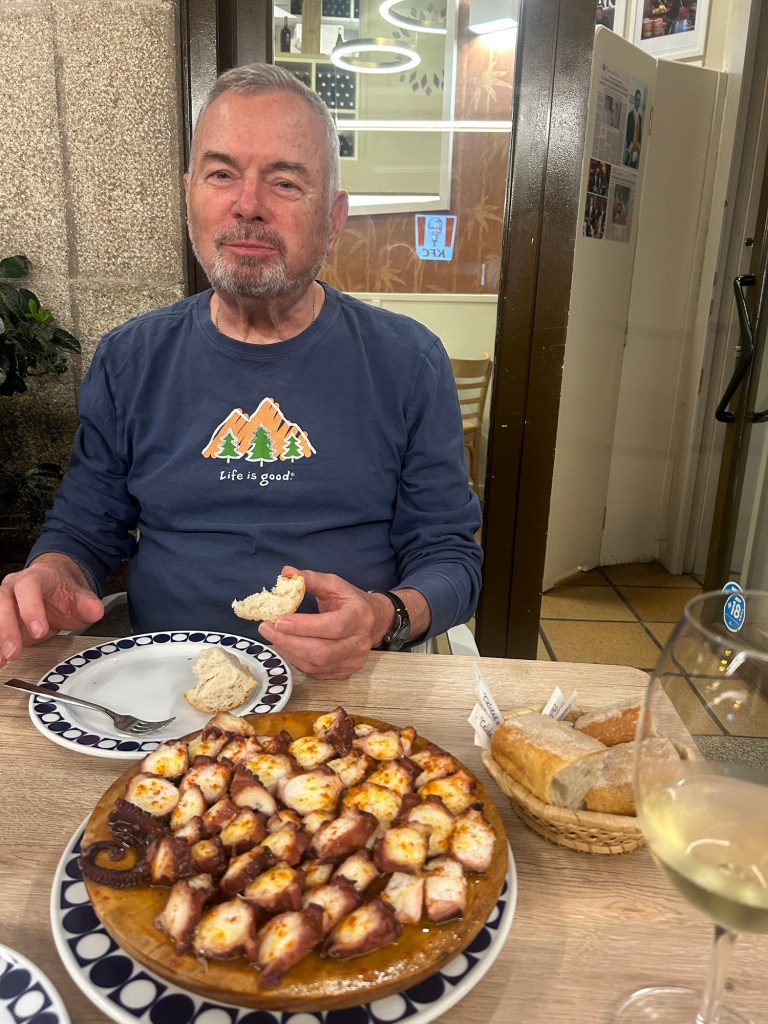
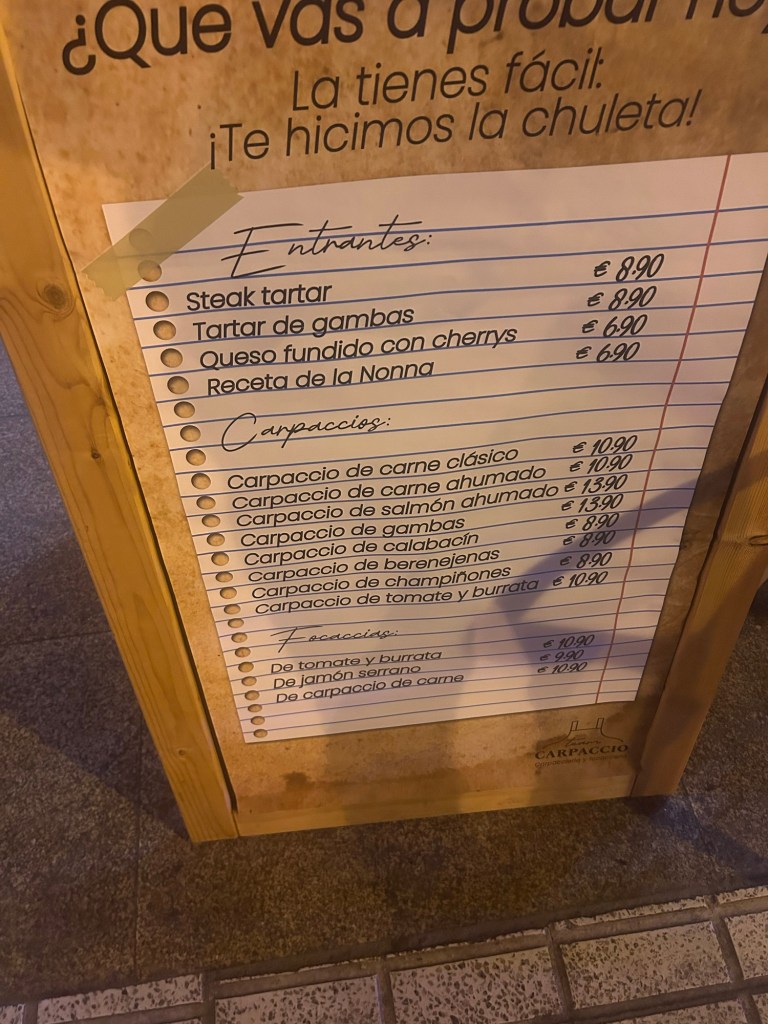
After a shower and a quick nap, we went out to explore Vigo and search for food. Fortunately, that is the easiest task in Spain as we came across about 9 restaurants in the first 3 blocks and we ate in 3 of them. two quick tapas while we waited for the kitchens to open up and one meal of pulpo (octopus). The prices are amazingly low. At two tapas places we each had a glass of wine and a snack for less than 7 Euros. I think I’d like to live here. See pictures
Pulpo ready to eatIn concourse B. Why are these men smiling?Happy pilgrim Choices of carpaccio
As a celebration of being cancer free over one year, my brother Joe and I will be walking the Camino Portuguese from the small fishing town of Vigo. This time we are accepting the assistance of an agency that has made all hotel arrangements and will move our luggage. There are those who would scoff that this is not a real Camino but as I have walked four sections before including the full French Way, the Portuguese Way from Porto, and the Santiago-Finistere-Muxia Way, I feel that I owe no one an apology.
Joe and I will fly from Newark to Porto just after midnight on 5 November and then be transported to our hotel in Vigo where we will acclimate on the 5th and 6th before walking on the 7th.
For several years, I have used this blog site to write about the Camino de Santiago. It started as a way of keeping family and friends aware of my progress. Later, with the unexpected and untimely death of my wife, Jean in June of 2018, the blog site took on an additional meaning. It was therapy for the intense grief I was feeling. I continued to write and post about Camino friends when we met for a mini reunion in Madrid in 2019 and again with my two short Camino adventures in 2022. The first from Sarria to Santiago with my brothers and my children and another short Camino from Santiago to Finisterre and Muxia following that in 2022. Now, I would like to take some time to tell the story of another Camino. My diagnosis of a blood cancer, Hodgkin’s Lymphoma, it’s effect on me and my several months of treatments. I hope that my telling of the experience will help others.
The story begins several years ago, perhaps in 2017 when I noticed three small lumps on the right side of my neck. I mentioned them to Jean. Jean, of course insisted that I make an appointment to see a doctor. I was not concerned about the lumps. I was getting older and lumpier. There was never any cancer in my family and I was in excellent health. Of course I went to see my Primary Care Doctor anyway. He referred me for a biopsy which came back “inconclusive”. I thought that perhaps I would check again in a year or so. What I did not know at the time was that within a year my beloved Jean would suddenly and unexpectedly die in an emergency room while we were in Connecticut attending a wedding. She was the healthiest, most alive person I knew. I was suddenly and totally an emotional wreck for the next two years and did little to nothing to take care of myself. This period of grief and self pity was immediately followed by two years of COVID isolation and all that came with it for all of us.
Suddenly, it is 2022 and plans to walk the Camino with my brothers Joe, 79, Greg, 63, daughter Amanda, 46, son John 41, and nephew Scott 30 were becoming a reality. We were all training and arrangements were being made for flights, trains, and albergues from Sarria to Santiago. I also had a plan to walk to Finisterre and Muxia with a college classmate and his wife. I was excited to be able to “share” the Camino experience and how much it meant to me with friends and family.
We started our walk from Sarria on 6 September 2023. We flew from Washington, DC to Madrid and took a train from Madrid to Sarria. In spite of my experience on the Camino and all the training I had done, I was having a very difficult time physically. This was embarrassing and unacceptable for me. I am not supposed to be the one who is having a hard time! I found myself sweating profusely and I was having serious pains in my legs (which I later found out to be IT Band syndrome). In spite of the difficulties, I was able to complete the two routes I had planned.
Upon returning home from Spain, I sought medical attention and physical therapy for the IT Band problems. I also read an article in the Mayo Clinic Newsletter about Lymphoma. The article was in a doctor’s office and it looked interesting. In the article, it had a diagram of all the lymph nodes on the human body and the symptoms of Hodgkin’s Lymphoma, a type of blood cancer. I could clearly identify the lymph nodes in my neck (which I had never gone back to have biopsied) as well as a list of symptoms to watch for. Among the symptoms were night sweats and profuse sweating. I was impressed at the plain language of the article as they stated “We are not talking about night sweats where you wake up with a moist brow. We are talking soaking wet and having to change your cloths and your sheets.” This is what I had been experiencing for years from time to time. I dismissed these occasions and assumed that they were diet and perhaps alcohol related since they only happened occasionally. In January of 2023, armed with this new knowledge, I went back to my Primary Care Doctor, he referred me for a biopsy and it came back Classic Hodgkin’s Lymphoma.
Now dealing with the emotional toll of a cancer diagnosis, I was scheduled for a PET Scan to determine the degree or stage of the cancer. This process was complicated by scheduling issues among the hospitals in the Charleston area as well as machines breaking down. Finally, on 10 January 2023, I had a good scan and an appointment with a highly recommended Hematologist/Oncologist. I met with the Doctor and his team on 19 January. The Doctor examined me and told me that he was referring me to the best Hodgkin’s Lymphoma Doctor in the area at the Hollings Cancer Center of the Medical University of South Carolina. After all the angst and waiting, suddenly I was on a fast track to treatments. Within three days I had an echocardiogram at my Cardiologists, a Lung function Test with a specialist, and a port placed in my chest just below my right collar bone (in order to facilitate the chemotherapy infusions). These procedures were required for the treatments as the chemotherapy drugs are notoriously hard on lungs and the heart so they were needed to establish a baseline before treatments.
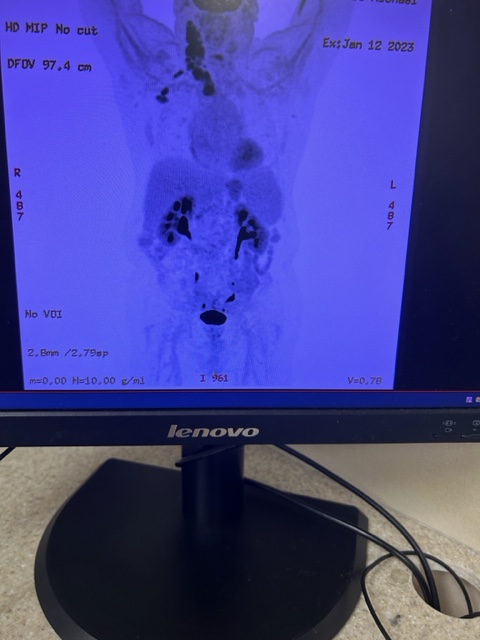
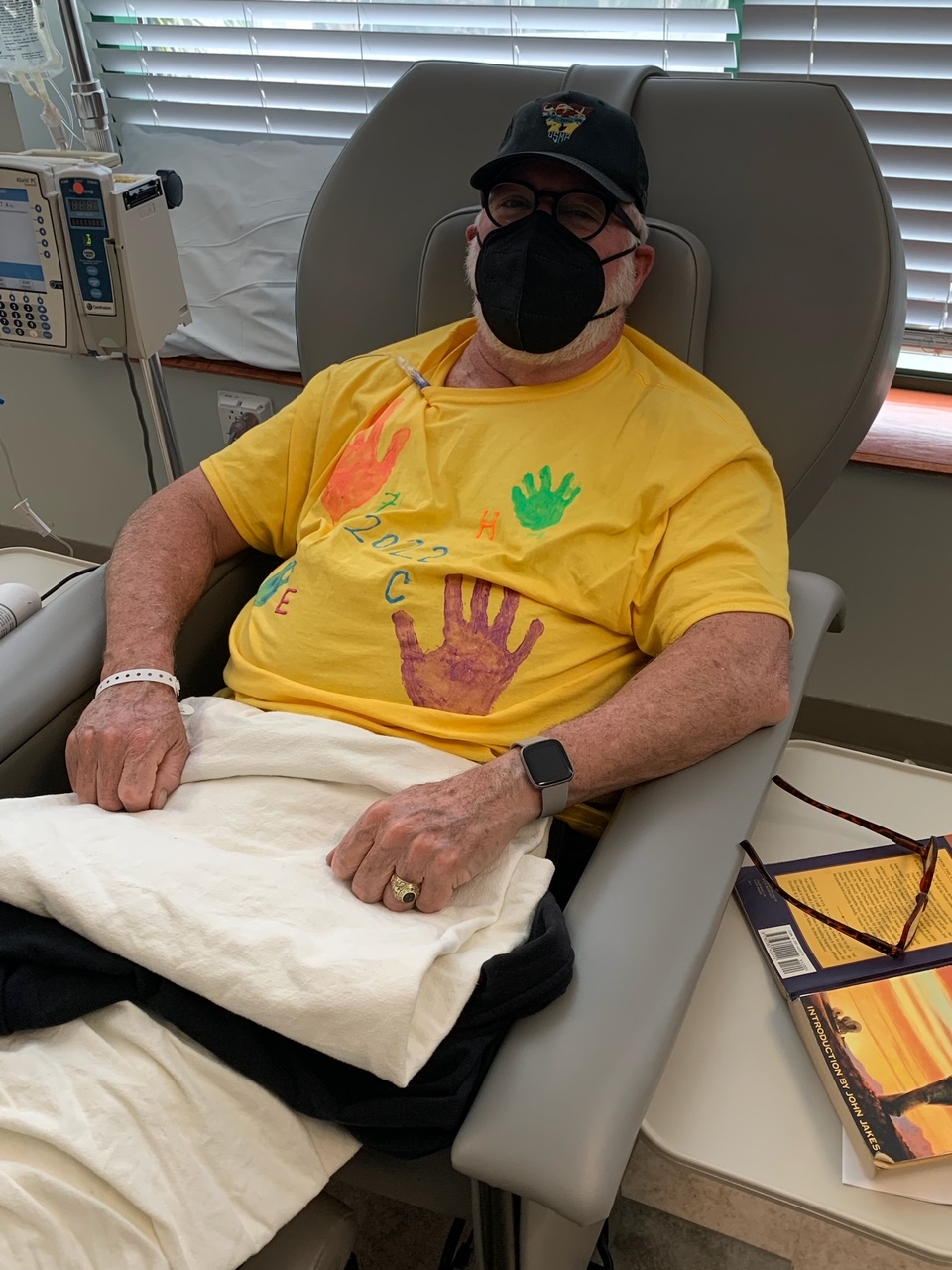
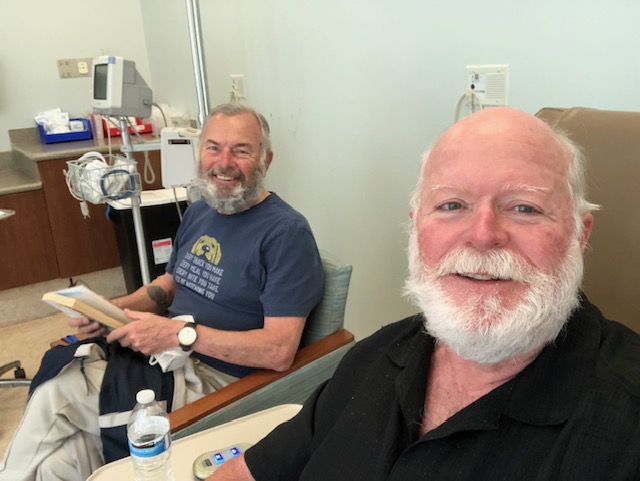
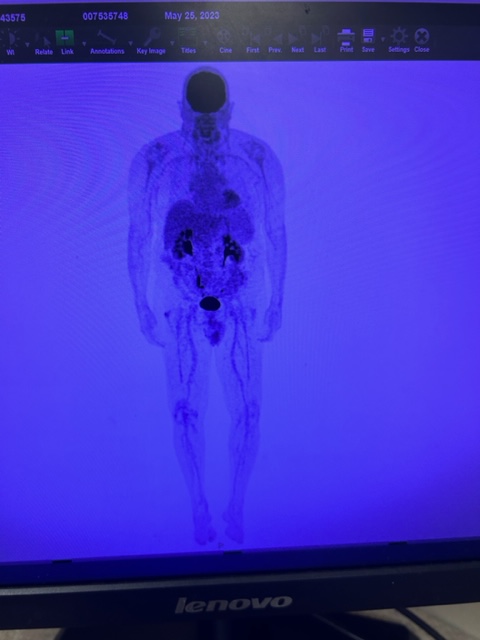
On 7 February, I met with the team at the Hollings Cancer Center and was counselled about the fact that I was stage 3 . (See the scan above. Note the dark lymph nodes on my neck) I was also informed that this should not concern me since Hodgkin’s Lymphoma was curable especially with this particular protocol of a combination of drugs. On 17 February, I had my first infusion. The treatments started ay 7:00 AM where they accessed the port to take samples for blood work that was amazingly comprehensive. This was followed by a meeting with the doctor and his team at 8:00, and on to the infusion nurse. They started me with three drugs that were referred to as Pre-Chemo drugs. These are designed to assist me in handling the side effects of the chemotherapy drugs. They generally consist of an anti-nausea drug, a steroid to boost your energy level, and an anti-viral drug. The first two infusions I had (two infusions 2 or 3 weeks apart are called one cycle) were Brentuximab Vendotin (BV). This is known as a targeting drug that specifically attacks Hodgkin’s Lymphoma. The infusion process was about a three hour ordeal. I had company, a snack, and plenty to read. I was warned to dress appropriately as three hours of pumping fluids into you in an air conditioned room can make you quite cold. There are warm blankets available. I also have learned that you can wheel the pole where the drugs are hanging into the men’s room without much problem. This was important for a man my age. My BV infusions were on 17 February and 9 March. Picture below is of my first infusion wearing a shirt with the hand prints of all four grandchildren, 19, 14, 4, 1nd 1).
I then entered a phase where I would have infusions every two weeks of the standard cancer chemotherapy “cocktail” of three drugs. They are Dacarbazine, Vinblastine, and Doxorubicib (DVD). These were to be every two weeks and they occurred on 29 March, 12 April, 26 April, 10 May, 25 May, 7 June, 21 June, and 6 July. These are the scary drugs that require the infusion nurses to don a sort of hazmat suit and call over another nurse to assist in making sure that all is right. The nurses were always professional and took great care to make sure that I was comfortable and getting all that I needed. The side effects of these drugs were an ordeal and will be for just about anyone. It is over these five months that I had my most difficult time. I had difficulty sleeping, I was constipated, light headed, and lost my hair and my beard of 25 years. The chemotherapy drugs attack cells that rapidly reproduce like cancer but also, those in your stomach and mouth, your skin, and your hair.) Since the chemotherapy reduces your white blood cell count, any spike in temperature over 100 is extremely dangerous and I was instructed to go immediately to the Emergency Room. This happened to me four times like clockwork four days after infusions in April, May and June. On 14 June, I was hospitalized for intravenous fluids and antibiotics. Early on, I also suffered from a rash, an allergic reaction to the chemo or combination of medications. We were able to isolate the offending drugs after a few weeks of trying and the rash cleared up.
On 25 May, I had a mid term PET Scan to determine our progress. It showed NO VISIBLE SIGNS OF CANCER. (See the scan below). This was thrilling news but the doctors reported that they would have to continue the chemotherapy since the cancer could be hiding in bone marrow or organs where it would not be visible. I was disappointed to learn that I would have to continue for several more months (well into 2024). Alas, at my 6 July meeting with the medical team, I was informed that the team had consulted with the doctor/author of the protocol and since I was doing so well (my bloodwork has been excellent), that they were going to eliminate two months of my chemotherapy (four infusions of the DVD). I would then have four final infusions of BV starting on 20 July. The knowledge of being cancer free and having an end date to my treatments does wonders for your attitude. I am thrilled.
I know that my recovery will take months after the last infusion. I have lost strength and stamina as well as body hair. I will also be immunocompromised for several months. Living like a shut-in hermit for seven months has not exposed me to even the common cold. I thank God for this recovery. I could not have done it without the tremendous support of family, friends, neighbors, and classmates around the country that continued to check on me and give me encouragement. I know how to get back in shape. It is on me now.
Thanks for listening. I hope this helps someone who may have to go through this or some similar ordeal. You can do it.

















 caminopapi